
Complete Guide to Customs Clearance of Chicken Feet for Iranian Exporters

Abstract
Exporting chicken feet, as one of the value-added products of the poultry industry, requires comprehensive knowledge of customs procedures and legal requirements. This article provides a complete guide for Iranian exporters to successfully clear their shipments through customs and send them to target markets.
Understanding the Export Customs Clearance Process
1-1. Definition of Export Clearance
Customs clearance refers to the process of legally releasing goods from customs for export from the country. For chicken feet exports, this process includes declaring the goods to customs, providing required documents, obtaining legal permits, and finally receiving the customs clearance permit for departure. Export clearance is generally less complex than import clearance, as exports benefit the country’s economy and the government has established facilitations for it.
1-2. Role of the Customs Clearance Agent (Customs Broker)
Due to the complexity of customs regulations and their continuous changes, using the services of an experienced customs clearance agent (customs broker) is strongly recommended for exporters. A customs broker is a natural or legal person with an official license who carries out the clearance process on behalf of the goods owner. A professional customs broker, with knowledge of the latest regulations, can prevent unnecessary costs and delays.
Required Documents and Certificates for Chicken Feet Exports
To clear chicken feet through customs, the exporter or their legal representative must prepare and submit the following documents to customs:
2-1. Basic Export Documents
Document Description
Customs Warehouse Receipt A document issued after the goods enter the customs warehouse, including weight, number of packages, and entry date
Invoice Includes product specifications, price, and terms of sale
Packing List Includes packaging details, weight per package, and number of cartons
Valid Commercial Card Copy of the exporter’s commercial card
Operating License For manufacturing companies
2-2. Special Legal Permits (Prior to Declaration)
Chicken feet, as a raw animal product, require special permits from the relevant authorities:
1. Health Certificate from the Veterinary Organization: This certificate confirms that the product is hygienically suitable for human consumption.
2. Standard Certificate (if applicable): Depending on the regulations of the destination country and domestic requirements, obtaining a standard certificate for exported chicken feet may be necessary.
Important Note: Failure to provide legal permits is one of the main reasons for goods being held up at customs.

Step-by-Step Process for Chicken Feet Customs Clearance
The export customs clearance process for chicken feet consists of the following steps:
Step One: Entry of Goods into Customs Warehouse and Receipt of Warehouse Receipt
After transporting chicken feet to customs premises, a customs warehouse receipt is issued. This document includes information such as shipment weight, number of packages, and the date of goods entry.
Step Two: Preparation and Completion of Documents
The exporter or customs broker must prepare and assemble all documents mentioned in Section 2.
Step Three: Goods Declaration through EPL System
Goods information—including type, value, quantity, and other specifications—is electronically registered in the EPL system (Single Window for Cross-Border Trade). Goods declaration can be performed directly by the shipment owner or their legal representative (customs broker).
Step Four: Receiving the Tracking Number (Cotage) and Determining the Declaration Path
After registration of the declaration, a Cotage number (dedicated tracking number) is issued. At this stage, the clearance path for the goods is determined:
⦁ Green Path: Goods are cleared without physical inspection.
⦁ Yellow Path: Requires document review and valuation, but no physical inspection is needed.
⦁ Red Path: Requires full document control, physical evaluation, and expert inspection.
Step Five: Goods Assessment and Expert Review
If the shipment falls into the Yellow or Red path, customs experts inspect the goods. This evaluation includes verifying the declared information against the actual goods.
Step Six: Obtaining Required Permits
If necessary, specific permits are obtained from relevant organizations (Veterinary Organization, Standards Organization, etc.).
Step Seven: Tariff and Declaration Value Review
The customs expert reviews the customs tariff and goods value, and upon approval, the declaration is forwarded to the payment unit.
Step Eight: Payment of Fees
Any export-related fees (if applicable) are paid.
Step Nine: Receiving Loading Permit and Goods Exit
After completing all steps, the loading permit is issued and the goods are released from the customs warehouse.

Key Points for Chicken Feet Export
4-1. Packaging and Product Quality
Packaging quality and product quality directly affect export success:
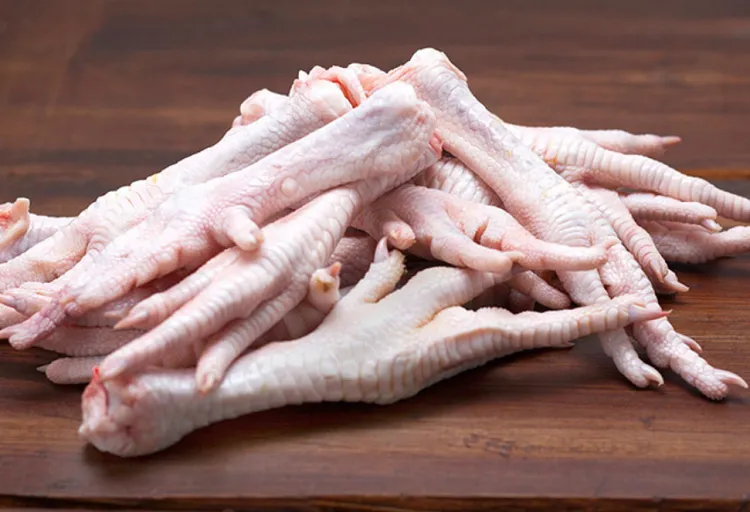
⦁ Standard Weight: Export-grade chicken feet typically weigh between 28-40 grams, with an average weight of 30-35 grams.
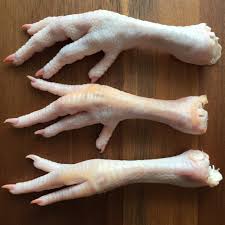
⦁ Appearance Quality: Chicken feet without darkening or footpad lesions (from walking) are considered the highest quality grade.
⦁ Freezing Tunnel: Use of a proper freezing tunnel gives the final product a pink color, indicating high quality.
4-2. Transportation and Cold Chain
Chicken feet must be transported in refrigerated containers capable of reaching -18°C. Each container typically has capacity for 1,400 to 1,450 20 kg cartons (approximately 28 tons). Carton packaging is usually in the form of 4 bags of 5 kg each or 2 bags of 10 kg each.
4-3. Target Markets
The main destinations for Iranian chicken feet are Southeast Asian countries including Vietnam, Myanmar, Malaysia, Thailand, and Hong Kong. Exports are also sent to Armenia, Uzbekistan, UAE, Turkey, Azerbaijan, and Iraq. Direct exports to China still face challenges and require the signing of joint protocols between Iran’s Veterinary Organization and China.
Conclusion
Customs clearance of chicken feet is a specialized, multi-step process requiring knowledge of customs regulations, obtaining health permits, and compliance with packaging and transportation standards. By using experienced customs brokers and strictly following administrative procedures, exporters can successfully clear their shipments through customs and send them to the lucrative Southeast Asian markets.
For more info call in web
Nonadshop.com



بدون دیدگاه