

Identification of Factors Influencing Illegal Sturgeon Fishing in the Southwestern Caspian Sea

Abstract

Illegal, Unreported, and Unregulated (IUU) fishing represents the most significant threat to the critically endangered sturgeon populations of the Caspian Sea. This article synthesizes findings from multiple empirical studies conducted in the southwestern Caspian region, particularly Iran’s Guilan, Mazandaran, and Golestan provinces, to identify the key factors driving illegal sturgeon fishing. Research utilizing Logit regression models, Structural Equation Modeling, and Analytical Hierarchy Process has revealed that illegal fishing is driven by a complex interplay of social, economic, fishery-related, and conservation factors. The most significant determinants include low income and job satisfaction among fishers, limited fisheries knowledge, lack of concern for sturgeon conservation, use of non-standard fishing gear, and inadequate awareness of penalties. Geographic factors such as fishing in deeper, more distant waters also contribute to the occurrence of illegal fishing. The findings demonstrate that illegal fishing is a multidimensional phenomenon requiring integrated policy interventions addressing economic empowerment, education, enforcement, and community engagement.

1. Introduction

1-1. The Conservation Crisis
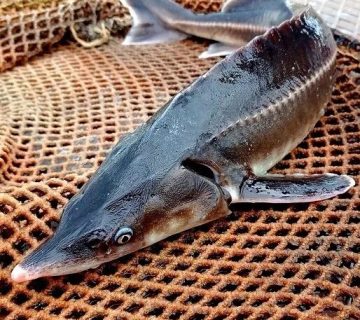
Sturgeon populations in the Caspian Sea have experienced catastrophic declines over recent decades, with all commercially valuable species now classified as Critically Endangered on the IUCN Red List . The Persian sturgeon (Acipenser persicus), Russian sturgeon (A. gueldenstaedtii), stellate sturgeon (A. stellatus), ship sturgeon (A. nudiventris), and beluga (Huso huso)—species that once supplied approximately 90% of the world’s wild caviar—now face imminent extinction .
The primary driver of this decline is excessive and illegal exploitation of aquatic resources . Despite the imposition of commercial fishing moratoriums by Caspian littoral states, illegal fishing continues at alarming rates, with illegal catch in the Caspian Sea being reported several times the legal catch . The persistence of this problem underscores the urgent need to understand the underlying factors that drive illegal fishing behavior.
1-2. Geographic Focus
The southwestern Caspian Sea, encompassing Iran’s coastal provinces of Guilan, Mazandaran, and Golestan, represents a critical area for sturgeon conservation. This region contains important spawning grounds, particularly in rivers along the Iranian coast, and serves as a primary habitat for Persian sturgeon . The Guilan subarea has been documented as having the lowest relative abundance of sturgeon, highlighting the severity of stock depletion in this region .
Given the ecological and economic importance of these stocks, understanding the causes of illegal fishing in this region is essential for developing effective conservation strategies.

3. Key Factors Influencing Illegal Sturgeon Fishing

Research has identified multiple categories of factors contributing to illegal sturgeon fishing in the southwestern Caspian region. These findings are synthesized below:
3-1. Social and Economic Factors
Study Level and Education
Research in Guilan province found that fishers with lower levels of education were significantly more likely to be involved in illegal fishing (P<0.05) . Fisher education level influences access to alternative livelihoods, understanding of regulations, and awareness of conservation importance.
A broader southern Caspian study similarly identified “fisheries knowledge” as a significant contributing variable . Fishers with poorer fisheries knowledge had a higher probability of committing IUU fishing .
Income and Job Satisfaction
Income level was identified as a significant factor (P<0.05), with fishers having lower income showing a higher probability of engaging in illegal fishing . Similarly, job satisfaction—measured as satisfaction with fishing as an occupation—was significantly correlated with illegal fishing occurrence .
These findings reflect that economic desperation drives illegal behavior. As documented in broader research, socio-economic issues, particularly unemployment in coastal communities, constitute key reasons for sturgeon stock decline .
Fish Price
The price of sturgeon products (meat and caviar) significantly contributes to illegal fishing occurrence . High market demand and premium prices create powerful economic incentives for poaching.
3-2. Fishery-Related Factors
Fishing Gear and Methods
The use of non-standard fishing nets was identified as a significant factor associated with illegal fishing (P<0.05) . Fishers using outlawed equipment have a higher probability of committing IUU fishing .
Fishing time was also a significant variable, with fishers who fish at night showing a higher probability of engaging in illegal activities . Nocturnal fishing provides cover from enforcement authorities.
Fishing Location
Research has demonstrated that illegal fishing is more concentrated on deeper and more distant fishing grounds . Geographic variables such as depth, distance from shore, and seafloor topography impact fishers’ decisions in targeting fishing grounds . Fishing vessel ownership was also a contributing factor .
Fishing License Status
Fishers without valid fishing licenses showed a higher probability of committing illegal fishing (P<0.05) . This indicates the importance of proper licensing systems for fishery management.
3-3. Conservation and Awareness Factors
Conservation Attitudes and Awareness
Fishers who gave less value to the protection of aquatic animals had a higher probability of committing illegal fishing (P<0.05) . Less concern for sturgeon conservation was associated with higher probability of IUU fishing .
Penalty Awareness
Awareness of penalties for illegal fishing was identified as a significant contributing variable . Fishers with limited understanding of enforcement consequences are more likely to engage in illegal activities.
Spatial and Demographic Influences
Analysis using structural equation modeling revealed that demographic factors (middle-age adults with higher literacy) and geographic variables (residence location and fishing zone) were positively associated with fisher attitudes toward sturgeon protection . Conservation attitudes were notably less positive among illegal fishing communities .
3-4. Expert Prioritization of Contributing Criteria
When fishery experts were surveyed using the Analytical Hierarchy Process, the contributing criteria to IUU fishing were prioritized as follows :
Priority Criterion Weight
1 Economic factors Highest
2 Social factors Second highest
3 Fishing/operational factors Third highest
4 Conservation factors Fourth highest
This prioritization confirms that economic pressures, social conditions, and operational aspects outweigh conservation considerations in driving illegal behavior.

4. Geospatial Determinants of Illegal Fishing

Beyond individual-level factors, research has identified important spatial patterns in illegal sturgeon fishing:
4-1. Fishing Ground Selection
Generalized additive modeling showed associations between the occurrence of illegal fishing and geospatial variables, indicating that illegal fishing was more concentrated on deeper and more distant fishing grounds . This suggests that illegal fishers deliberately target areas that are harder to monitor.
4-2. Spatial Variability
Mapping of areas under fishing pressure illustrated that fishers target broad fishing grounds with spatial variability in targeted boundaries across the sea due to geographic and ecological variations, such as the slope of the continental shelf .
4-3. Regional Variation by Province
Research across Iran’s three northern provinces revealed differences in the importance of various factors:
Province Key Findings
Guilan Significant social and economic factors
Mazandaran Variable effects of conservation-related variables
Golestan Variable effects of conservation-related variables
These provincial differences highlight the need for regionally tailored conservation approaches.

5. Broader Context: Systemic and Institutional Factors

Research has identified several underlying systemic factors that create conditions conducive to illegal fishing:
5-1. Institutional Weaknesses
Key barriers to effective sturgeon conservation include :
Lack of effective management and sustainable exploitation of fish stocks
Insufficient revival and protection measures for stocks
Inadequate policy-making and investment in the fisheries sector
Absence of effective inter-governmental agreements on common fishery policy for shared stocks
Lack of integrated or ecosystem-based approach to fisheries management
5-2. Socio-Economic Conditions
Following the collapse of the Soviet Union, coastal populations faced almost complete unemployment due to the closure of state-owned agricultural farms (“kholkozes”) . This economic disruption increased poaching. Reduction of state budgets weakened fisheries and trade enforcement, increased corruption, and decreased fisheries investment, particularly in restocking programs .
5-3. Organized Crime
Illegal sturgeon fishing has taken organized forms, particularly in regions such as the Ural River and the Kazakh part of the Caspian Sea . Among the main causes of the illegal turnover and poaching are unemployment problems of the local population, high demand for sturgeon products abroad, and insufficient government control .
5-4. State Policy Paradox
A study of sturgeon poaching in Dagestan revealed a concerning dynamic: despite a decrease in active fishing brigades, fishing effort per brigade increased by nearly 50% (from 4.33 to 6.42 months), resulting in a 49% increase in catch per brigade . This suggests that state containment policies have not curbed poaching and may have inadvertently spurred effort intensification. The state’s hatchery program may function as a political compensatory mechanism that inadvertently subsidizes the illegal fishery .
6. Comparison with International Research
The findings from southwestern Caspian studies align with broader research on illegal fishing:
6-1. Common Drivers
Research in the Persian Gulf has similarly identified socio-economic factors as key drivers of illegal fishing, suggesting that the patterns observed in the Caspian reflect broader regional dynamics .
6-2. Need for Integrated Approaches
The multidimensional nature of illegal fishing—involving economic, social, operational, and conservation factors—indicates that integrated approaches are necessary for effective prevention .

8. Conclusion

Illegal sturgeon fishing in the southwestern Caspian Sea is driven by a complex set of interacting factors spanning social, economic, fishery-related, and conservation domains. Research using rigorous quantitative methodologies has identified that fishers with lower education levels, lower income, limited fisheries knowledge, less concern for conservation, and use of non-standard gear are significantly more likely to engage in illegal fishing .
Expert prioritization confirms that economic and social factors exert the strongest influence on illegal fishing behavior, followed by operational and conservation factors . Geographic determinants also play a role, with illegal fishing more concentrated in deeper, more distant waters . Underlying institutional weaknesses and broader socio-economic conditions create an environment conducive to illegal fishing.
The findings indicate that illegal fishing is not a simple problem with a single solution; rather, it is a multidimensional challenge requiring integrated policy interventions. Effective strategies must address economic pressures through livelihood diversification, enhance education and awareness, strengthen enforcement capabilities, engage local communities in conservation, and improve institutional frameworks. Without such comprehensive approaches, sturgeon populations in the southwestern Caspian will continue their trajectory toward extinction, with profound ecological and economic consequences.
For more info call us
Nonadshop.com




بدون دیدگاه