
A Comprehensive Analysis of Global Caviar Financial Turnover and Value in 2024
Introduction
Caviar, the black pearl of the culinary world, has long been a symbol of luxury, wealth, and the refined taste of aristocrats. But beyond being a lavish delicacy, caviar has evolved into a multi-billion-dollar industry that underpins the fisheries economies of several nations. If you want to know the real financial turnover of caviar worldwide, which countries dominate this market, and what prices per kilogram this strategic product has reached, stay with us until the end of this article.
What is the Global Caviar Market Value in 2024?
According to the latest international market analysis reports, the global caviar market was valued at approximately $350 to $400 million in 2023. Forecasts indicate that with a compound annual growth rate (CAGR) of around 7 to 9 percent, this figure will reach $700 million by 2030.
This significant leap is primarily due to the transition from wild caviar (which has been almost eliminated from the official market due to environmental bans) to the sturgeon aquaculture industry. Today, more than 90 percent of the caviar consumed globally comes from farmed sources, making supply more stable and predictable.
Caviar Financial Turnover in Major Markets
Financial turnover is not limited to direct caviar sales; it also includes farming equipment, fish feed, processing, packaging, and exports.
1. Europe: The Beating Heart of Caviar Trade
Italy, France, and Germany are the largest producers and consumers of farmed caviar in Europe. Italy alone accounts for over 15 percent of global production. The annual financial turnover of caviar on the continent is estimated at over €150 million. Italian brands such as “Agroittica” and French ones like “Sturgeon” set astronomical prices for their products.
2. China: The Rising Giant
With massive investment in Heilongjiang Province, China has become one of the world’s largest producers of farmed caviar. China’s low-cost production (mainly from Siberian sturgeon and hybrids) has revolutionized the global market and created intense competitive pressure on traditional producers in Russia and Iran. It is said that China alone is responsible for nearly 30 to 35 percent of global production volume, although its quality is generally rated lower than Caspian caviar.
3. Russia and Iran: A Return to the Golden Era?
· Russia: Russia is seeking to revive the “Russian caviar” brand. With the ban on wild fishing, the country has established huge farms along the Volga River. Russia still holds the most iconic caviar brand in the minds of global consumers.
· Iran: Iranian caviar is still considered the most expensive in the world due to its unparalleled taste and authenticity. Despite sanctions, Iranian Beluga and Ossetra caviar is sold at exorbitant prices in luxury markets in Europe and the UAE, either through smuggling or intermediaries. Iran’s official caviar financial turnover is around $20 to $30 million annually, but its real value in the black market and through brokerage is much higher.
Price Analysis: How Much Does a Kilogram of Caviar Cost
 ?
?
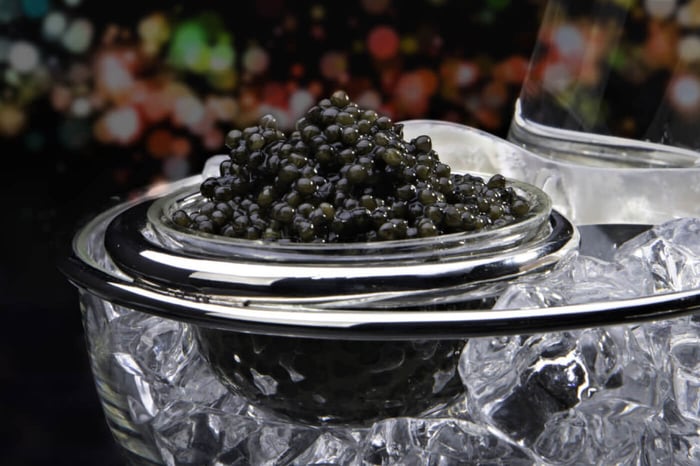
The price of caviar heavily depends on the fish species, producing country, fish age, and processing method. The table below provides an overview of wholesale prices in global markets:
Caviar Type Approximate Price per Kilogram (Wholesale) Characteristics
Beluga $5,000 – $12,000 Largest grain, creamy and delicate, rarest and most expensive
Osetra / Russian $1,500 – $4,000 Medium grain, nutty flavor, popular among connoisseurs
Sevruga $700 – $1,500 Small grain, stronger and saltier taste
Siberian / Baeri $400 – $800 Mass-produced (China and France), suitable for beginners
In retail and restaurant markets, these prices typically increase 3 to 5 times. A single teaspoon of Beluga caviar in luxury restaurants in London or Dubai can cost between $50 and $200.
Key Drivers of Caviar Financial Turnover Growth
Why is investment in the caviar industry becoming increasingly attractive?
1. Growth of the affluent class in Asia: In China, South Korea, and the Middle East, caviar consumption as a status symbol is rising sharply.
2. Increasing health awareness: Caviar is rich in Omega-3, vitamin B12, and minerals. Advertising about anti-aging and immune-boosting properties has moved it beyond mere luxury.
3. Development of gastronomy tourism: Five-star hotels and business-class airlines have incorporated caviar as a standard on their menus, creating steady demand.
Market Challenges and Risks (Why Is Investment Risky?)
Although caviar profits are astronomical, its financial turnover carries high risks:
· Payback period: Sturgeon fish require 7 to 15 years to produce eggs. This is a long-term investment with heavy maintenance costs.
· Pollution and disease: High-density farms (especially in China) face the risk of aquatic disease outbreaks that can wipe out the entire investment.
· Currency fluctuations and sanctions: Iranian and Russian producers lose part of their revenue due to banking restrictions and money transfer limitations.
Conclusion and Future Outlook
The global caviar financial turnover is undergoing a transformation. The era of wild fishing has ended, and the age of “industrial farming and luxury branding” has begun. Analysts predict that in the coming decade, hybrid caviar at lower prices will capture the majority market share, while pure Iranian and Russian caviar will become a collectible and investment commodity traded only at auctions and specialized markets.
If you are looking to enter this market, focusing on digital marketing, direct-to-consumer (D2C) exports, and guaranteeing organic quality will be the key to success in this fierce competition.
What do you think? Could investing in farmed caviar in Iran become a suitable alternative to oil? Share your thoughts with us in the comments.
· Primary keyword: caviar financial turnover, global caviar price, caviar market.
· Secondary keywords: Beluga caviar, farmed caviar, Iranian caviar export, caviar market value.
FOR MORE INF CALL US IN
NONADSHOP.COM
PARVISICO.COM

بدون دیدگاه